

Investing is both a science and an art.
The science can be learned. You can read about inflation, interest rates, asset allocation, tax wrappers, legislation and long-term market returns. These things matter. They give you the foundations.
But the art of investing is different.
The art is not really learned from a textbook. It is learned by living through difficult periods without abandoning a sensible plan.
It is learned when the headlines are loud, markets are falling, and doing nothing feels like the hardest option available.
From time to time, it is useful to look back. Not because history repeats perfectly, but because it reminds us how often the world feels uncertain at the time, and how different things can look with hindsight.
Six Years in Events
It is now more than six years since the start of 2020.
In that period, investors have had to live through a remarkably busy run of market-moving events.
Markets are relatively calm today, but they have recently come through the US-Iran / Strait of Hormuz crisis, which is not fully resolved. So this feels like a good moment to look back at what investors have actually faced.
We often imagine major market events as rare things, separated by long quiet stretches. The recent past has not felt like that.
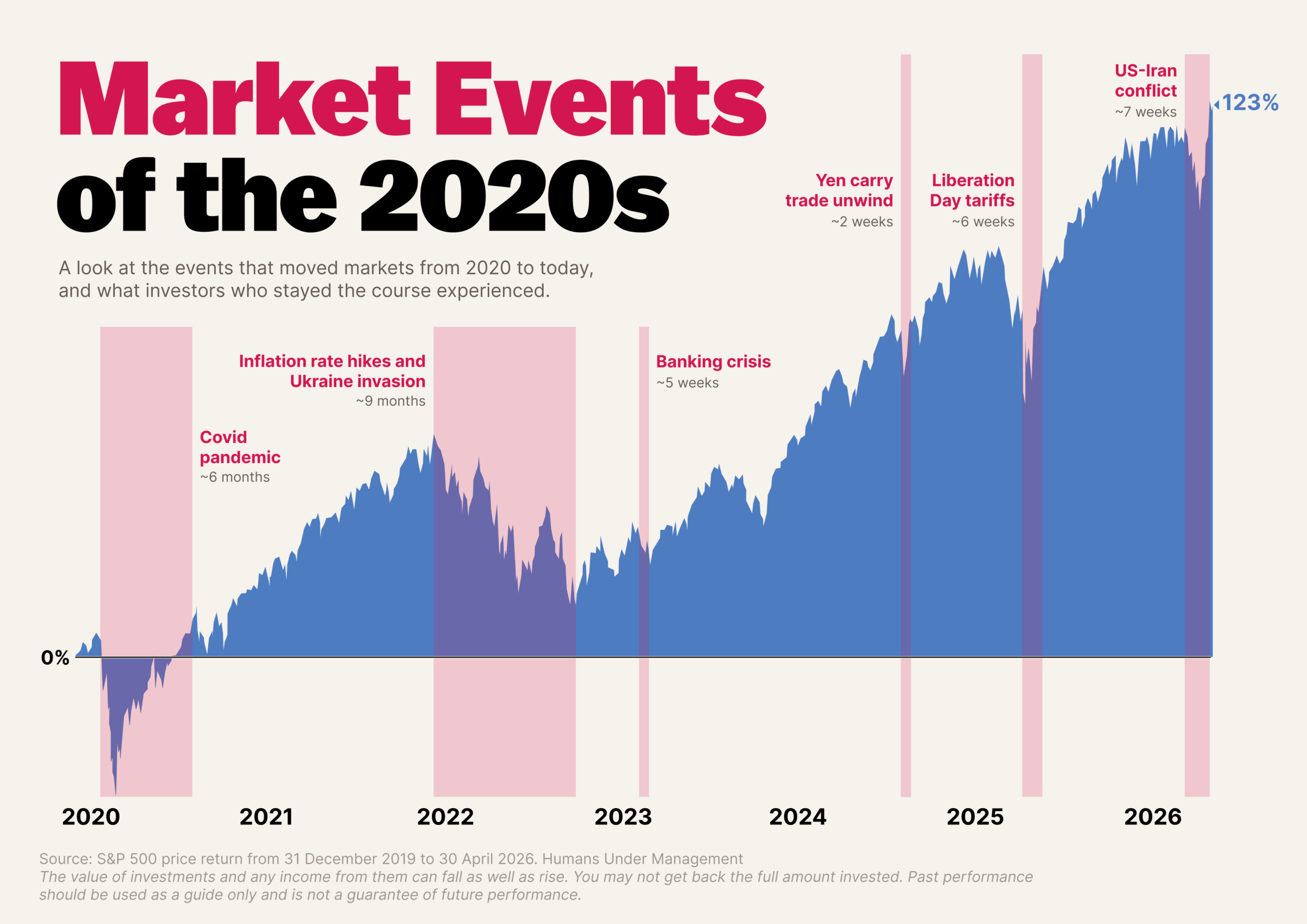
Since the start of 2020, investors have seen:
March 2020: Covid shuts down the global economy. The S&P 500 falls by around 34% in 23 trading days.
2022: Russia invades Ukraine. Inflation reaches 40-year highs. Interest rates rise sharply. Markets enter a bear market.
September 2022: The UK mini-budget triggers a gilt market crisis.
March 2023: Silicon Valley Bank, Signature Bank and Credit Suisse collapse within weeks, raising fears of another banking crisis.
October 2023: The Hamas-Israel war begins.
August 2024: The yen carry trade unwinds. Japan’s Nikkei suffers its worst day since 1987, and global markets are pulled lower.
January 2025: DeepSeek triggers a global technology sell-off. NVIDIA loses nearly $600 billion of market value in a single day.
April 2025: Trump’s “Liberation Day” tariffs trigger a sharp fall in US markets.
March 2026: The US-Iran conflict and the closure of the Strait of Hormuz create another oil shock and another market scare.
That is quite a list.
And yet, through all of that, long-term investors were not mainly being tested on their ability to predict the next event.
They were being tested on their ability to stay invested.
Six Years in Numbers
At the end of 2019, before any of this began, the S&P 500 closed at around 3,231.
By the end of April 2026, it had reached around 7,209.
That is a gain of more than 120% over a little more than six years.
Over the same period, the earnings of the companies within the index also rose substantially. In plain English, the businesses owned by investors continued to grow their profits despite everything listed above.
That is the part investors often forget.
Markets do not rise because the world is calm. They rise over time because businesses adapt, innovate, cut costs, raise prices, find new markets, and keep producing goods and services that people need or want.
This does not mean every worry was imaginary.
Covid was real. Inflation was real. War was real. Banking stress was real. Political risk was real. The oil shock was real.
The point is not that these events did not matter.
The point is that the emotional weight of an event at the time is not the same as its long-term investment significance.
That distinction is one of the most important lessons an investor can learn.
The Balance We Are Trying To Hold
Good investors do not ignore the world.
They stay informed. They understand risk. They accept that markets can fall sharply and without warning.
But they also understand that reacting to every frightening headline can be more damaging than the event itself.
The challenge is not to be emotionless. That is unrealistic.
The challenge is to have a plan that is robust enough to survive emotion.
If you have remained invested through the last six years, you have already lived through more market history than many investors experience in decades. You have seen how quickly fear can appear, how convincing the case for caution can sound, and how costly it can be to sit out the recovery.
That experience is valuable.
The science of investing gives you the plan.
The art of investing is learning to stick with it when the plan is being tested.
Please note:
This blog is for general information only and does not constitute advice. The information is aimed at retail clients only.
The value of your investment can go down as well as up and you may not get back the full amount you invested. Past performance is not a reliable indicator of future performance.